
Ygor Marcolino
23rd February 2026

Economic logic and the challenges of the transition to renewable energy
The growth of the debate surrounding sustainability across all sectors of society is undeniable. The persistent increase in greenhouse gas emissions — largely stemming from traditional energy sources — threatens the environment and, consequently, social well-being. In this context, the natural response, already widely adopted by various countries, has been a commitment to renewable energy.
The European Union, for instance, through the European Green Deal, has established ambitious carbon neutrality targets for 2050. China, according to public commitments announced by the current government, has set the goal of achieving neutrality by 2060.
However, as the debate intensifies and public policies are implemented in this field, several questions and implications arise. Thus, this article seeks to provide an introductory analysis of the balance between cost, feasibility, and the economic impact of renewable energies, highlighting their respective challenges and opportunities.
Current Landscape
According to the International Energy Agency’s (IEA) 2024 executive summary, the current pace brings the world closer to the goal of tripling renewable generation capacity by 2030; however, additional measures are still required to bridge the gap regarding the commitments established at COP28.
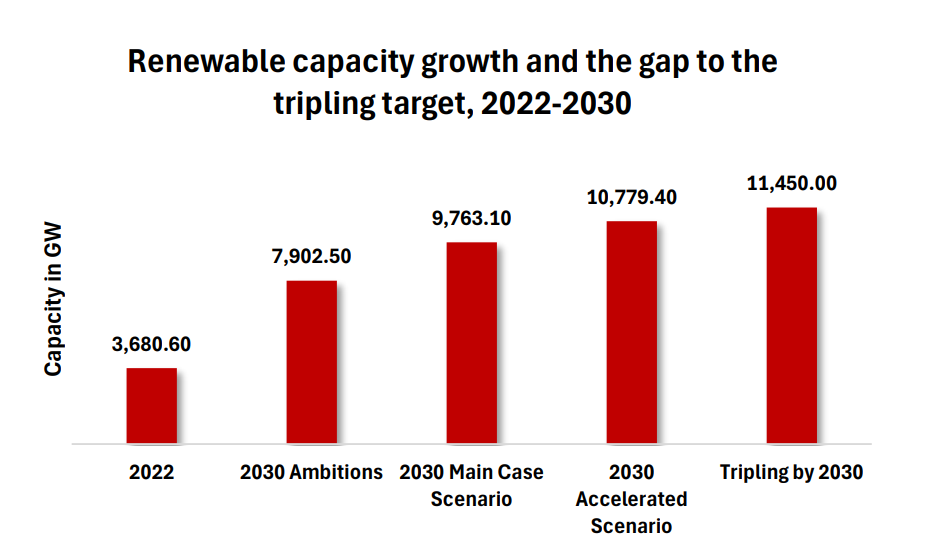
Source: International Energy Agency. (2024). Renewable capacity growth and the gap to global tripling, 2022-2030. Paris: IEA. Available at: https://www.iea.org/data-and- statistics/charts/renewable-capacity-growth-andthe-gap-to-global-tripling-2022-2030 (Accessed on September 15, 2025). License: CC BY 4.0. Chart prepared by the author based on IEA data.
In 2023, the global final energy consumption mix was composed of approximately 13% renewable energy². Driven by significant efforts from both governments and the private sector, and according to IEA projections, this figure is expected to increase by 53%, reaching nearly 20% by 2030.
This is where the first impact of economic reality emerges: solar and wind energy are projected to account for 95% of the growth in renewable capacity — further propelled by their increasing economic competitiveness³.
The primary challenge lies in making diverse renewable energy sources economically competitive against established and historically inexpensive fossil fuels. Without this advantage, the sector tends to become less attractive for private investment or remains dependent on public subsidies to sustain itself. While this hurdle is being progressively overcome by certain energy sources, it remains a significant challenge for others.
Explicit and Implicit Costs
The economic viability of renewable energy raises key questions: geographical suitability of the resource, generation capacity, capital and operating costs, as well as the design of public incentives.
A gradual reduction in the costs of these technologies has been observed. One of the most widely used indicators to assess this trend is the Levelized Cost of Energy (LCOE). This indicator estimates the unit cost of power generation based on a discounted cash flow model. What studies — both national (such as in the United States⁴ and Germany⁵) and international — consistently demonstrate is that renewable energy has become increasingly competitive compared to traditional fossil fuel sources.
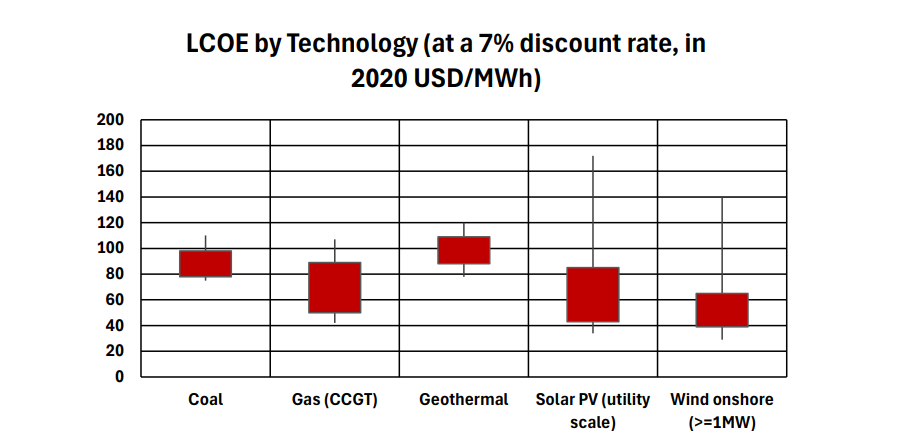
Source: International Energy Agency. (2020). Projected Costs of Generating Electricity: 2020 Edition. Paris: OECD/IEA. Available at: https://www.iea.org/reports/projected-costs-of-generating-electricity-2020 (Accessed on September 15, 2025). Chart prepared by the author based on IEA data.
Globally, median costs for utility-scale solar and onshore wind are already below the LCOE of gas (CCGT) and coal⁶ . In these two cases, the impact of technological development, business competition, and government support is prominent. Solar modules saw their spot prices⁷ drop by about 50% in 2023 alone⁸ , marked by strong government incentives, innovation, and market growth. In the case of wind power, investment reached 180 billion dollars in 2023⁹ — it is also relevant to highlight the role of the private sector in driving this source through Corporate Power Purchase Agreements (PPAs). The increase in economic competitiveness is becoming increasingly evident not only in onshore wind and solar but also in other sources, such as hydropower.
Despite this good news, the economic and social viability of these sources continues to face challenges.
First, renewable energies require a meticulously prepared infrastructure network¹⁰ . The construction of wind farms, hydroelectric plants, or solar panel arrays requires local implementation capacity and an effective connection to the power grid. Furthermore, the intermittency and variability of generation make grid refinement and storage solutions indispensable. Without government intervention to promote greater integration, inefficiency risks increase significantly. An example of this was the fact that, recently, curtailment levels — the intentional reduction of energy production resulting from oversupply or grid limitations — reached 10% in some countries¹¹, a problem that can only be overcome by strengthening infrastructure.
Secondly, a joint effort between the State and the private sector is indispensable. As highlighted in the Global Landscape of Renewable Energy Finance 2023: “It is now widely recognized that blended finance — the strategic use of concessional finance to mobilize additional private capital — is an essential tool to mitigate investor concerns and support long-term market growth, especially in niche and less commercial renewable energy technologies” (Mutambatsere and de Vautibault, 2022, as cited in IRENA, 2023, p. 66).
Beyond direct public investments, the development of renewable energy has grown with the private sector’s contribution, driven by subsidies, tax incentives, and the increasing competitiveness of technological costs. The continuity of these stimuli and investments is undoubtedly one of the fundamental pillars for the consolidation and expansion of renewable energy.
Thirdly, it is observed that energy storage has become as important as generation itself. Renewable energies face the intrinsic problem of variability and a lack of synchronization with demand: wind, solar radiation, and hydrological regimes are, by nature, volatile. Without adequate storage solutions, aligning production and consumption becomes practically impossible.
The challenge gains greater dimension when analyzing the figures. At the end of 2022, the total installed grid-scale battery storage capacity was about 28 GW. However, in the net-zero scenario for 2030, this value will have to reach approximately 970 GW — a nearly 35-fold increase¹².
As a result, perhaps the greatest challenge and question surrounding renewable energy emerges: energy security. If there is no sun, wind, or any other type of “fuel” associated with the renewable source in question, supply becomes extremely difficult, if not impossible, to satisfy social and economic needs. In a scenario of robust growth in energy demand — driven by artificial intelligence software, data centers, and population growth itself — energy security assumes an increasingly central role in the functioning of a new economy.
In this sense, increasing the storage of surplus may seem like the most intuitive solution. However, there is still no storage technology that is simultaneously scalable and economic to fully solve this challenge. Lithium-ion batteries, for example, remain relatively expensive and present relevant weaknesses: they are subject to fire risks from overheating and, although efficient for small daily fluctuations, are chemically unsustainable for long-term energy accumulation¹³ . Additionally, the geographical factor is significant, as the supply of lithium is limited and concentrated in a few countries, a fact that cannot be overlooked.
It is certain that systems can resort to fossil fuel backup plants, such as gas, to ensure continuity of supply¹⁴ . However, from a sustainability perspective, the question arises: given the systematic increase in energy demand, how often will these backup systems need to be activated?
Therefore, both private investment and the design of the energy mix require greater caution, placing storage and energy security at the center of decisions. The capacity to store and integrate this energy into the grid — in coordination with flexibility mechanisms — has become a decisive condition for the viability of projects.
Finally, the geographical factor is, and likely will continue to be, determinant. It is a fact that all LCOE costs and values vary significantly depending on the geographical characteristics of each location. Public and private investments must, therefore, consider generation capacities in a personalized manner.
Conclusion
In conclusion, the economic viability of energy sustainability presents a promising, yet challenging, future. A consistent reduction in renewable energy costs is observed, alongside gains in efficiency and innovation. Furthermore, growing social awareness has favored its adoption, which remains a key factor in attracting private investment.
By overcoming the primary identified obstacles, through the synergy of both the public and private sectors, environmental necessity can be effectively aligned with economic and social demands, contributing to the construction of a more sustainable future.
¹ International Energy Agency. (n.d.). Greenhouse gas emissions from energy data explorer. Paris: IEA. Available at:
https://www.iea.org/data-and-statistics/data-tools/greenhouse-gas-emissions-from-energy-data-explorer (Accessed on September 15, 2025).
² International Energy Agency. (2023, October 24). Massive global growth of renewables to 2030 is set to match entire power capacity of major economies today, moving world closer to tripling goal. Paris: IEA. Available at:
https://www.iea.org/news/massive-global-growth-of-renewables-to-2030-is-set-to-match-entire-power-capacity-ofmajor-economies-today-moving-world-closer-to-tripling-goal (Accessed on September 15, 2025).
³ International Energy Agency. (2024). Renewables 2024. Paris: IEA. Available at:
https://www.iea.org/reports/renewables-2024 (Accessed on September 15, 2025).
⁴ Lazard. (2023). Levelized cost of energy+ (LCOE+). New York: Lazard. Available at:
https://www.lazard.com/research-insights/levelized-cost-of-energyplus-lcoeplus/ (Accessed on September 15, 2025).
⁵ Fraunhofer Institute for Solar Energy Systems ISE. (2022). Levelized cost of electricity: Renewable energy technologies. Freiburg: Fraunhofer ISE. Available at:
https://www.ise.fraunhofer.de/en/publications/studies/cost-ofelectricity.html (Accessed on September 15, 2025).
⁶ International Energy Agency & OECD. (2020). Projected costs of generating electricity 2020. Paris: IEA/OECD. Available at:
https://www.iea.org/reports/projected-costs-of-generating-electricity-2020 (Accessed on September 15, 2025).
⁷ Spot price. (n.d.). Definition: price practiced for immediate delivery of a good or service, without future or deferred contracts.
⁸ International Energy Agency. (n.d.). Solar PV. Paris: IEA. Available at:
https://www.iea.org/energysystem/renewables/solar-pv (Accessed on September 15, 2025).
⁹ International Energy Agency. (n.d.). Wind. Paris: IEA. Available at:
https://www.iea.org/energysystem/renewables/wind (Accessed on September 15, 2025).
¹⁰ International Energy Agency. (n.d.). Renewable integration. Paris: IEA. Available at:
https://www.iea.org/energysystem/electricity/renewable-integration (Accessed on September 15, 2025).
¹¹ International Energy Agency. (2023, October 24). Massive global growth of renewables to 2030 is set to match entire power capacity of major economies today, moving world closer to tripling goal. Paris: IEA. Available at:
https://www.iea.org/news/massive-global-growth-of-renewables-to-2030-is-set-to-match-entire-power-capacity-ofmajor-economies-today-moving-world-closer-to-tripling-goal (Accessed on September 15, 2025).
¹² International Energy Agency. (n.d.). Grid-scale storage. Paris: IEA. Available at:
https://www.iea.org/energysystem/electricity/grid-scale-storage (Accessed on September 15, 2025).
¹³ Knowable Magazine. (2024, May). Developing renewable energy storage methods. Knowable Magazine. Available at:
https://knowablemagazine.org/content/article/food-environment/2024/developing-renewable-energy-storagemethods (Accessed on September 15, 2025).
¹⁴ International Energy Agency. (n.d.). Natural gas. Paris: IEA. Available at:
https://www.iea.org/energysystem/fossil-fuels/natural-gas (Accessed on September 15, 2025).